Friday, July 22, 2011

The Pursuit of Sadness

My favorite music source, NPR's All Songs Considered, recently opened their channel to a collection of people. The request: "what song makes you cry?". I loved the idea of the invited discussion. As we grow older our intuition to cry tends to fade away. We become more aware of our ability to control our emotions and we compartmentalize accordingly. I found it surprising, however, that people who shared stories with Bob Boilen and the crew talked mostly of love lost.

I have loved and lost but it helped me find my wife....so I don't have to cry about that any more. The tears always revisit me through great music....mostly because I am so happy to be alive in this god forsaken place. When the aforementioned love of my life and I sat at my birthday dinner a few years back, I told her that I was saddened that the ride may be half way over. Sadness hits me when I realize that this life is fleeting - and then I Go Live It!

For the record, a few from my "songs that make you cry" list would be:
A Letter to Elise by The Cure
Never Went to Church by The Streets
Keep Me in Your Heart By Warren Zevon
Troubled Times by Fountains of Wayne
...these among thousands

As a dude in his late 30's with a wife and kids, the tears these days are those of joy. I cried about a lot of stupid shit in my 20's.

Lady Gaga turned the world's most apathetic haters into fans with her in-studio performance on The Howard Stern show. One could not help but love the assumed over-hyped diva because she showed up, played the piano well and shared unadulterated emotion through her art.

It is a shame we have become so sanitized in our human delivery that a little genuine humanity makes us cry. But, that's life. We get so caught up in day to day detail that we forget to LIVE. We worry about the insignificant and forget the people who genuinely matter as they frown in the background of our tortured lives.

When it comes to Love, sometimes you lose that battle. I have news for you my little 25 year old heart broken hearted angel: It Doesn't Matter! I promise, you will find the one you are looking for and those tears will show up again for the right reasons. A reminder that life is fragile and it cannot be wasted in fussing over trifles. Celebrate your every moment for at some point they will be tears on anothers pillow: irreplaceable, delicate, the premise of survival.

Don't Forget to Remember!

Dave

Wednesday, July 20, 2011

Easy is Nothing

I have been reading Start With Why by Simon Sinek and have enjoyed the book immensely. Among other great concepts, Simon introduces the difference between Manipulation and Inspiration.
It seems to be common place in the working world that we believe the way to motivate people is through manipulation (carrot and stick). There has been an onslaught of criticism of Generation Y and their unwillingness to conform, yet we keep the carrots and stick at hand. In essence, we know that manipulation is an inelegant approach but we continue the practice. I interviewed Dan Pink a few weeks back and asked why he thought defacto training was replacing education in the workplace. He noted that it was easier and we tend toward the simpler solution.

So there we have it: trade the practice of changing lives in the workplace for a safe and uninventive process. 

Purpose driven companies are acutely aware of their differentiators and use them as their Primary Organizational Mission.

Unfortunately, purpose driven companies are few and far between. At some point, inspiring people in the workplace became too risky. You have to monitor what you say, ask only of your employees what seems reasonable, measure performance by job description...do the safe thing, leave well enough alone and wallow in mediocrity. It's easier that way.

Zappos have created a model for company culture. People are now saying, "we have embraced the Zappos model".....No, you haven't! We are so hung up on manipulation that we are in denial of our inability to inspire. Zappos makes a daily practice of doing the hard thing. This is why their culture is great. They empower employees, put themselves on the social media edge, use 'above and beyond' customer service as their SOP, allow the personal aspects of their team to drive their company brand, and always think a step ahead. Unless you have enough balls to practice the aforementioned engagement mission, don't pretend you have embraced the Zappos model.

By starting with why, Simon Sinek has helped companies rediscover their genuine organizational purpose. They need not concern themselves with appeasing Generation Y or trying to be like Zappos. They simply need to know that people buy not what they do but why they do it.

Remove the dust from over the Core Values on your lobby wall. Remember what made your company great and continue to be great. There are no easy answers or defacto training...every day will be an inventive challenge. If you want to be a great company these are the things that you need to consider. Doesn't that sound easy?

Don't Forget to Remember!

Dave    

Friday, July 15, 2011

Social Awareness

As a Human Resources Strategist, there are 2 requests that are consistently reiterated to me:
1. How can my company be more like Zappos?
2. How do I write an iron-clad Social Media Policy?

The enquiries of competing ideologies are a microcosm of the double life delegated to HR Pros.

The Great Tony Hsieh recently address the question of social media policy at Zappos. I will paraphrase his feedback:
Our social media policy is pretty simple, we hire people for reasons that would validate that we are comfortable with them using social media under the Zappos brand.

Zappos is a great organization because they understand that people come first. Zappos is a company driven:
1. Individual Personalities
2. Core Values
3. Great Customer Service
....you will note that policy and/or organizational process are not listed in their drivers to success.

So, I can't "make your company like Zappos" if your position description is driven by words like: governance, regulation, policy, performance reviews, exit interviews, etc....

HR has been commoditized to corporate police. Do you think HR at Zappos faces liability.....you bet they do...they are HQ-ed in Vegas and have a bunch of 20 somethings working for them!!!! However, Tony Hsieh, his senior leaders and his legal team would don't heap said liability on said 20 somethings when they enter the office on any given day. Zappos remains an exemplary corporate culture because they keep their policy in the ivory tower and let the natives play. They celebrate what's great about their talent and leave the "legal implications of one's behavior" to the lawyers.

Too often in HR we focus on protecting our brand instead of sharing it. We regulate behavior instead of rewarding it. We write policy instead of educating of core values. We focus on performance reviews instead of service celebration.

Tony Hsieh also commented that you don't need to be a start up with a young workforce to be like Zappos...all you need to do is to align your people with your core values. Question: do you know your company's core values? Can you recite them? Do you live by them? Core Values are the only thing, in any company, that promote uniform purpose to all people regardless of title. Unfortunately, they have been reduced to words on a wall covered by dust in most places.

I know HR Pros want to focus on hiring not firing. I know HR Pros want to spread culture not regulate behavior. We just can't seem to shake the commodity we have allowed ourselves to be reduced to.

Want to be like Zappos? Trust your talent and align them with your uniform organizational purpose.....is that so hard to do?

Don't Forget to Remember!

Dave

Tuesday, July 12, 2011

How To Get To Heaven

With the insane amount of work I do on a daily basis, I occasionally get immersed in detail. At the point my sanity begins to wane...I make an effort to pull myself back into reality. Through a long walk with my I-pod my reflection keeps me grounded. My latest development:
No One Ever Got Into Heaven for Doing Their Job Well

(I am not an overly-religious person but you get the almighty metaphor)


Simon Sinek's book "Start With Why" has been a pillar in our organization. The premise:
The WHAT (detail of job requirement) is insignificant. One must be driven by the WHY (genuine personal purpose).

Mr. Sinek validates the point of my recent stress reduction walk in the woods. We will never be remembered for submitting a report on time, hitting our quota, or for ordering office supplies efficiently. The mundane detail comes and goes. We get task obsessed, expect a great deal from one another and question our professional relevance. My guess is that the last time you walk out the office door people will remember you not for what you did but why you did it:
Were you a decent person to be around?

I regret to inform you, dear readers, that I have lost sight of my children's moments in the sun because I was side tracked by my blackberry. I have insulted people I care about and have missed countless hours of sleep over things that are out of my control.

As foolish as it seems...I just care (a lot). I wish I wasn't as intense as I tend to be. I sometimes wish I didn't care so much.

Here's what I know:
~ I go to the same coffee shop every day. Not because I like their coffee, I like the people who work there.
~ I drink the same beer all the time because of the dedication the brewer puts into each and every pint.
~ There are certain musicians whose words hug my heart (the accompanying instrumentation not the song's primary attraction).

In starting with WHY:
*People make up for faulty products
* Business Mission trumps inefficency
* People who have walked in our shoes remind us how to run


This life is fleeting. We cannot let the job description distract us from that which is genuinely important to us.

Don't Forget to Remember!

Dave

Tuesday, July 5, 2011

5 Questions for Dan Pink

I became aware of Dan Pink when a colleague of mine introduced me to his book, "A Whole New Mind". Having an appetite for business journalism, I was constantly seeking new professional motivation via the printed page. Mr. Pink's book provided a shocking reassurance. His description:
Lawyers, Accountants, Computer programmers. That's what our parents encouraged us to become when we grew up. But Mom and Dad were wrong. The future belongs to a very different type of person with a very different kind of mind.


He goes on to describe how right brain thinkers (me) will rule the world. He was right. Mom and Dad were wrong....that's all I needed to hear.


A lawyer by degree, Dan Pink has a knack for enticing healthy debate. This trait served him perfectly in his break through presentation at TED. In this presentation, Mr Pink introduced the concept of his latest book, Drive. Where "A Whole New Mind" challenged the relevance of formal education to one's professional motivation, "Drive" promotes education in the workplace. In debunking the carrot and stick process of motivation, Dan Pink frustrated the less inventive thinkers in the incentive industry and opened the door for a new breed of motivators...focused on the process of education as the greater goal to long term development.


Dan Pink afforded me a few minutes on the 4th of July 2011. He is an all-American guy who is willing to take time away from the parade for his admiring public.

1. I loved the concept of Symphony in "A Whole New Mind". Do you have a formula for bringing consistency to seemingly unrelated events?


No. I think it's less of a formula and more of a general attitude. Are you open to new ideas -- no matter where they come from? Are you reading in areas outside your own professional expertise? Are you talking to a wide range of people? When you put together a team, do you make sure there are diverse viewpoints? People who make this sort of behavior habitual generally do pretty well on Symphony.


2. In “Drive” you challenge the carrot and stick formula of prize for performance. How has this message been received by HR professionals?


So far, the response has been great. But I think HR professionals are more astute on these matters than many others in organizations -- because the very best among them spend their time and energy working on talent. They know that money does matter to talent -- but that it's not ultimately what gets them up in the morning. HR professionals can be hugely important ambassadors in bringing the science of motivation inside of organizations.


3. How important is Empathy in leadership?


It's hugely important. It's very hard to lead without being able to see the world through the eyes of those your leading. That's especially true for creative teams. And it's doubly true for the growing ranks of people who are leaders but who don't have much formal authority -- and therefore must rely on influence rather than command. There's also some recent research, led by Adam Galinsky at Northwestern University, that shows that as people accumulate power, they're less likely to see the world from another's perspective, which can often hamper their abilities to get others to go along with them. Leadership turns out to be a very delicate balance between action-orientation and perspective-taking. Too much of one rarely works.


4. Why have some companies simplified the process of education in the workplace down to product knowledge?


It's easier -- and they know how to do it. Plain and simple.


5. You are one of the most recognized business authors of our time yet you always make time to respond to your readers. How do you balance this?


Hmmm. I'll resist my lawyerly instinct to disagree with your premise and instead thank you for the overly generous assessment. On the matter of responding to readers, it's not all that complex. First, I like it. I learn a heckuva lot from readers and I always appreciate hearing from them. Second, it's the right thing to do. If someone spends 10 or 15 dollars and several hours of their time reading one of my books, the least I can do is spend zero dollars and five minutes of my time responding to their question. To me, what's weird is that everybody doesn't do this.


To find out more on all things Pink visit: http://www.danpink.com/


Don't Forget to Remember!


- Dave


Wednesday, June 29, 2011

SHRM 2011: The Good & The Bad

I must admit, I went into SHRM11 feelings a little apprehensive. The expectation of programming that might let attendees down, the prospect of standing on my feet for 3 days straight, and the pre-formed guilt of the swag footprint always makes me painfully self-aware. As usual, I was wrong to go in feeling uninspired! I saw so many of my virtual friends in the Social Media lounge, was totally blown away by the keynotes, had great conversations with HR Pros from all over the world, and discovered some really great new companies.

In all, it was a marvelous time in Las Vegas. Our company was smart enough to put us up at the Green Valley Ranch; far enough from the strip to avoid creating the concept for Hangover 3. We behaved well at night and we're charged up to make the most of swagville by day.

The Good:
* Tony Hsieh - I have always enjoyed Tony's fun loving approach to doing business. I have seen him present before and have read his book. It is awesome that he was willing to promote his vision to the world of HR. John Hollon wrote a great piece on Tony's Keynote - check it out!

*The SHRM HR Blogging Community - It is no secret that I Love Laurie Ruettimann - she is like the little sister I never had. Totally upbeat but perfectly realistic. The Great Robin Schooling dropped by our booth to discuss wine, the lottery and the Saints. She honors the namesake of her favorite football team. Paul Smith dropped in during down time for a meaningful conversation about influencing managers to help employees make good decisions. Paul is one of my favorite writers and even more engaging in person. I also waived at China Gorman, gave Charlie Judy a high five, and exchanged salutations with my friend Trish McFarlane. The degree of influence that social media has gained @ SHRM over just the last 3 years because of the aforementioned people is simply remarkable! Keep fighting the good fight!

* Bright - My favorite new company....They have a super cool platform, totally engaged employees, and a feeling of purpose in their booth that radiates hope.

* Dice - This vendor hired Laurie Reuttimann, Steve Boese, and China Gorman to speak as HR Experts in their booth - a inventive and profitable decision.

*TLNT - I thought it was just a blog...apparently it's an actual company. Amazingly cool people and great writers who are kind enough to throw us all the part. The troops are throwing an event in Austin this is a can't miss.

The Bad:

* The only complaint I have about SHRM11 is the immaturity of vendors. Several times members of competitive organizations came to our booth in request for information. Some sent their loved ones, others dressed in costume, and there were those who were bold enough to show up and take our collateral (readily available on our website). While their methods were varied they have one thing in common: They think we're stupid! I know who you work for and I don't care what you know about my company. I never worried about competition. I concern myself with forging great relationships, finding customer's who mirror our company philosophy, and developing ways to make companies better.

"Don't Chase the Paper, Chase the Dream" - P Diddy

Thanks to Fabulous Las Vegas and all the people that made SHRM11 a massive success!

See you in Atlanta in 2012!

Don't Forget to Remember!

- Dave

Thursday, June 23, 2011

Welcome to Swagville!

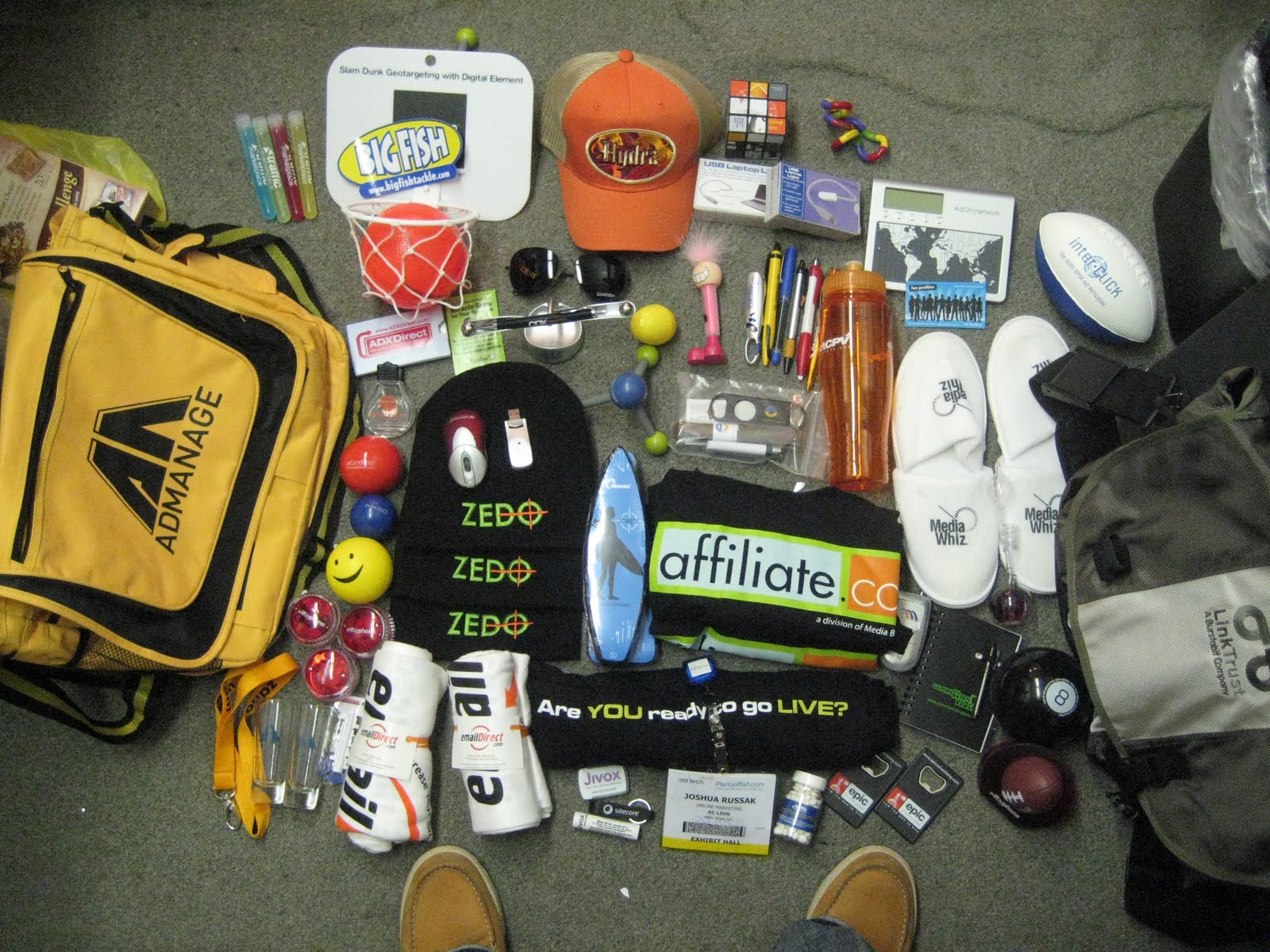
The 2011 SHRM Conference is upon us. Attend a few courses, get your certifications renewed, see some old friends....maybe do a little site seeing or grab a drink. But there is a 12,000 pound Elephant in the conference center: SWAGVILLE!

Also know as the Exhibitor Hall, Swagville is a place where uniformed sales people scan your badge and give you a collection of logo-ed items.

I am wondering if this elephant is a necessity. For "vendors" it is an opportunity to essentially have thousands of client meetings in one day. For "attendees" it is an opportunity to gather a bag full of branded toys for the kids.

Question: Have you ever implemented an organizational program because of a logo-ed stapler?

Maybe you have. Maybe the impression of a logo on an office aid actually has an impact. Maybe if you are a kid growing up with a logo-ed stapler in hand, you are forever involuntarily embedded with brand loyalty???

Vendors pay A LOT of money to exhibit at conferences. The quality of the various conversations usually opens opportunity for new partnerships and the investment is paid for. But, I am wondering if the swag is necessary? If you walk past a booth and grab a pen does it have any relevance to making your business better? Does a stuffed animal actually encourage you to seek out a vendor for help?

These chotsky's break pretty easily, they are extra stuff to carry on a plane, and the branded bag they come in will probably taint your fruit if you use it at the farmers market.

So, there is no business relevant conversation, you are forever surrendered to an email list referencing a product that has no significance to the job function you perform...the junk soon breaks and is trashed. Bad for the environment, costly to vendors, meaningless to attendees.


In 2012, I propose we eliminate the swag! All vendors take their previous year's swag budget and make a charitable donation. The Exhibitor Hall is now reserved for people who are serious about adding a product/service to compliment their organization. If you are not a decision maker or do not have a need for a service, you can avoid the Exhibitor Hall. This promotes meaningful and relevant conversation among people who are genuinely invested in forming partnerships. I would bet the same ROI would come to the vendors and meaningless transactions would be terminated.

Businesses grow and prosper, kids are spared the disappointment of their favorite branded toy breaking in half, the environment is spared and a charity of each vendors choosing is rewarded with money they can genuinely use!

Let's get back to partnership building with a purpose! Let's make the world a better place!

Don't Forget to Remember!

Dave

Tuesday, June 21, 2011

A Challenge to HR


Going into the 2011 Society for Human Resource Management Global Conference, I feel it my duty to re-iterate the "top workplace trends according to HR professionals" conveyed at the onset on 2011:
1. Continuing high cost of employee health care coverage
2. Passage of federal health care legislation
3. Increased global competition for jobs, markets and talent
4. Growing complexity of legal compliance for employers
5. Changes in employee rights due to legislation and/or court rulings
6. Large numbers of Baby Boomers leaving the workforce at around the same time
7. Economic growth of emerging markets such as India, China and Brazil
8. Greater need for cross-cultural understanding/savvy in business settings
9. Growing national budget deficit
10. Greater economic uncertainty and market volatility

In short; Globalization, The Economy, and a whole lot of policy. I guess Laurie Ruettimann was right, HR is all about politics.

How do:
1. Leadership
2. Organizational Strategy
3. Innovation
....fit into the HR notebook?

Should we be concerned that the Administrative stereotypes of Human Resources are re-enforced by the aforementioned survey? If HR really wants a "seat at the table", we need to focus less on legalities and more on our influence in driving organizational strategy.

We need to attract and hire great talent, evolve our company culture with the changing generational dynamic, create programs that drive thought leadership, and foster an employee-centric organizational environment. If these things seem obvious why are they not showing up as our peak concerns. We need to put down the Employee Handbook and pick up the Organizational Playbook.

Every employee in every company starts and ends with HR. We need to be a pipeline from Employee to Senior Managers:
Adopt a Strategic Program Management Plan
Create a Funnel from Employee to CEO
Stop Ignoring the Facts


What Would Google Do...
At the World at Work Global Compensation and Benefits Conference, the Google Compensation Team revealed a case study detailing how they revolutionized Compensation in their organization. Google gave every employee a 10% pay raise and a $1000 spot bonus. As we left their panel discussion a man turned to me and said, "I sure would like to work at a place where 10% pay raises were a reality...but I never will". Many from the conference had similar reactions, but they missed the point. Monica Davis and her team at Google developed a strategic plan for program adoption:
1. Listen to Employees
2. Gather and Analyze Data
3. Obtain Approval
4. Communicate
5. Build a Model
6. Implement

The key of this presentation was not that Google has millions of dollars to shell out on the ready (because they don't). The Google team wanted to show other HR professionals how to be business relevant.

When you come to the board room with data and a communication model to drive employee adoption; the CEO will actually ask you to "sit at the table".

The Voice of the Little People
I've never met a CEO that has any idea of a entry level professional's level of discontent with organizational directives. We implement performance reviews, surveys, and town hall meetings in an effort to gather employee feedback. Most employees feel they will be cast in a bad light if they point out areas of organizational deficiency in these forums. So they keep their mouth shut and work around organizational challenges.

This is where HR needs to assert leadership. Every HR Leader knows where the organization is falling short. With data in hand, and a plan for restructuring, we can be the driving force to organizational improvement.

What are you afraid of..?

Watch Your Back...
I worked for an organization that had a technique. Gather exit feedback from employees...then run to those who have been complained about and warn them to watch their back. This is how mediocre organizations stay mediocre, great employees leave for greener pastures, and bad middle management maintains it's place in marginalizing talent.

We are in denial! We start a 'good ol' boy/girl network' and protect our own. Millions of dollars are spent opening exits for true talent while protecting people who suck at their job. What a shame.

Another opportunity for HR to bang on the Boardroom door and demand attention.

So, as we enter the conference center in Las Vegas for the 2011 SHRM Annual Conference, I want to issue a challenge to every HR professional at every level...

Acquire knowledge to solidify your position as a Change Manager!

Gather tools to improve your strategic approach, the courage to convey information and the uncompromising drive to make your company better!

Don't Forget to Remember!

Dave

Thursday, June 16, 2011

5 Questions for Dave Kovacovich

I am starting a new series on DFTR called 5 questions. Once a week, I will showcase some of my favorite people by asking them differentiating questions. The goal is to give my readers an alternative view of the professional world through the eyes of those who have fought the good fight and won!

If you or someone you know would like to be part of this series just let me know.

Our first guest on the 5 Questions series is me....here is the transcription of an interview I did with myself on the car ride to work this morning. I hope you enjoy this guest, he is one of my favorite people!

1. You have made some professional adjustments that have really benefited you as a person. How did this work?
I was caught up in the corporate rat race. My goal was to climb the ladder of a large corporation. I wanted to align myself with the right people, accept additional responsibility, and bring attention to my achievements...it all back fired. I was young so I let the bravado of my motivation overwhelm my body of work. I was far too transparent in my ulterior motives and people got sick of me. When the light at the top of the ladder went dim, I had to switch careers.

I did a total career make over. I went from a large company to a smaller one, transferred from Technology to Human Resources, and started working from home. I made a commitment to let my work speak for itself. I stopped speaking up on conference calls and in meetings (unless called upon). I realized I had created a lot of extra, unnecessary stress in navigating my career path. When I let my work speak for itself the success wasn't forced. I saved a lot of time and a lot of hair follicles.

2. What do you enjoy most about working with HR Professionals?
I enjoy helping the more administrative team members develop confidence. There are folks who have been kept in generalists roles because of their lack of confidence. It's awesome to empower introverted people by helping them design a program (while giving them the metrics to defend their decision). I love it when a Senior Manager gives me a the 'go ahead' on a new program and the aforementioned catalyst is promoted.

3. Most Salesmen are fast talking jerks, how have you tried to avoid that stereotype?
I try to listen more than I talk, think with the customers mind, answer questions directly, make the solution applicable to a conveyed need, and to infuse some common sense.

As sales people, we tend to get hung up pretending to be product experts. Prospects don't care about our product knowledge, they care about how the product will fix a need, bring value to their company, and make their job easier. We get too hung up on touting our product without taking time to understand why (or if) our prospect needs what we're pushing. I hate to see a prospect ask a simple yes/no question and get a 10 minute product capability dump (that doesn't address their question). You wanna be a successful sales professional: listen and apply your solution to a conveyed need....and don't be afraid to say your product is incapable of doing certain things. Prospects appreciate salespeople who are not submissive to every request.

4. What are the latest trends in the world of Employee Recognition?
Who cares! Our industry tends to lack creativity. We latch on to themes like Employee Engagement and Motivating Millennials and we pretend we have a one size fits all solution. I don't believe there is such thing as an industry expert and I don't believe in best practices. Every industry, company, and employee have unique identities...trying to throw a blanket over it, makes consulting a commodity.

5. You are a big fan of sports and music. How do your personal preferences relate to your profession?
It's all about inspiration. I love the thrill of victory. Seeing the underdog overcome pre-conceived adversity makes me believe I can do anything. It's the same with music. I listen to Bon Iver and the sound scape opens my soul...I instantly forget the mundane pressures of life and I am filled with purpose for the moment. The challenge is always remembering the great stuff. Music and sports help me remember how amazingly awesome I can be.

Life is good for Dave! He lives to work because he loves his work. He loves his work because he takes no detail too seriously, has great relationships, and celebrates the strengths in everyone around him.

Next week we will talk to another amazing professional with genuine intent. Until then...

Don't Forget to Remember!

Dave

Monday, June 13, 2011

The Strategic Process of Wasting Time

Last week, we spoke about authenticity in the workplace. Earlier this week, I authored a piece on the desire for Empathy from Leaders. Today, we will take this a step further...why must we be so dishonest in the workplace?

Think about it....we hold back emotion, frame language to sound more appropriate, dress a certain way, and neglect pointing to things with which we disagree. All because we don't want to be unprofessional.

I think we have it backwards! I think we should drop the bravado and get down to what helps us win!

Disclaimer: No, I am not advocating that you say what is on your mind, in any audience, at any time!

What I intend to impress upon you is that we waste a lot of time allowing "process" to trump common sense. We think ourselves experts, we design strategy....and we often forget common sense.

Here are 3 considerations for common sense in the workplace:
Exceptions to Expectations
The Real Reason You Care
Consideration of Audience

Rules, Rules, Rules.....
I remember over hearing an Administrator ask our General Manager if she had to fill out a report for the XYZ vendor approval.

To which he answered: "Yes, and what's the XYZ vendor approval?"


Must we have a formalized process in place to defend each and every decision we make? It may be conveyed that this is the best way to prioritize resources.....it really means we have to have documentation to cover our ass.

How much time is wasted on "process"?

We have meetings about meetings. You are held on the phone for 30 minutes to hear excuses from someone who does not have 30 minutes to complete the documentation you requested. Wouldn't it be refreshing if we could approve or deny business initiatives on the spot and move on with our day? Why can't we?

The Meltdown
I wish I had a dollar for every time I have seen an adult throw a tizzy fit. We are on the phone, web, or in a conference room deciding how to manage a particular project. Any ideas....?

Yeees, there are plenty of ideas, a whole lotta chiefs, and not nearly enough Indians. Are we genuinely focused on the team's success or do we just want our name stamped on a project. Do we think this directive will assist in organizational development or do we want the validation of having an idea adopted? Do we really need to conduct meetings about meetings or are we just there to speak and pretend to be part of something?

The boss is coming, act busy....
The most idiotic thing I've done as a professional is spouted my opposition to organizational directives in the presence of a Vice President. The VP didn't make his annual visit to hear about the mundane detail of my day, I had no evidence to support my claim, and my teammates cringed as I put myself on the 'people to fire' list.

There will be times when you can speak openly, there are co-workers with whom you can be completely honest, and there are times when you might have to stick up for yourself. But, consider your audience.

A VP doesn't want to hear excuses. Just because your friends think you are right doesn't mean they want you to speak on their behalf. You should respect the guy in the warehouse as much as the lady in the board room.

It comes down to this....we waste an inordinate amount of time on process and idea promotion. In reality, we don't care about either.

At some point we need to determine that there are things we cannot change. The best way to accept the inevitable is to smile, keep your mouth shut, and let those who do nothing pretend to be part of your success.

Don't Forget to Remember!

Dave